

Imagine a detective trying to solve a complex case with just one single clue. It sounds risky, right? They might miss crucial details or even jump to the wrong conclusion. Diagnosing issues within the human auditory system, a complex pathway, presents a similar challenge. Relying on just one test can sometimes be misleading. That’s why, as audiologists, understanding two fundamental concepts is absolutely key:
- The Test Battery Approach and
- The Cross-Check Principle.
These aren’t just fancy terms; they are the basis of reliable and accurate auditory diagnosis. This post will try to break down exactly what these principles mean. Why they are so vital in our field. How mastering them makes us more confident and effective clinicians.
The Power of Many: Understanding the Audiology Test Battery Approach
So, what exactly is this Test Battery Approach? Simply put, it means using a combination of different audiological tests instead of relying on just one to assess a person’s hearing system. Think of it like playing cricket you wouldn’t use just one single short for every ball. Similarly, the auditory system is complex, with different parts and functions. A single test might only give you information of one specific area.
Why is this variety so crucial?
- Firstly, different audiological tests evaluate different aspects of hearing. Some tests, like Pure Tone Audiometry (PTA) or Speech Audiometry, are behavioral hearing tests – they rely on the patient’s response. Others, like Tympanometry (part of Immittance testing), Otoacoustic Emissions (OAEs), or Auditory Brainstem Response (ABR), are objective hearing tests – they measure physiological responses and don’t require active participation. Using a mix helps us pinpoint where a potential problem might lie, from the outer ear all the way to the auditory nerve and brainstem.
- Secondly, patient factors matter. A young child, an elderly individual, or someone with developmental challenges might not be able to reliably complete certain behavioral tests. Objective measures become invaluable in these situations.
- Furthermore, every test has its limitations. Using multiple tests provides a more robust and comprehensive hearing assessment.
The benefits are clear: the test battery approach in audiology gives us a much fuller picture of the patient’s auditory status. It significantly improves diagnostic accuracy. Helps identify the specific site of the hearing issue (site of lesion), and allows us to effectively assess even those patients who are traditionally considered ‘difficult-to-test’. It’s about gathering diverse evidence to build a strong diagnostic case.
To remember why the test battery approach is so crucial, think of the SCORE mnemonic:
SCORE
- S – Site of lesion identification becomes easier with multiple tests.
- C – Cross-checking ensures consistency and builds diagnostic confidence.
- O – Objective and behavioral measures complement each other.
- R – Redundancy improves reliability — one test backs up the other.
- E – Evaluation of difficult-to-test patients becomes possible using non-behavioral tools.
This quick mental checklist can guide you during both academic learning and clinical practice.
Why do we need test battery
- Improved Diagnostic Accuracy
- Detection of Inconsistencies
- Reduction in Misdiagnosis
Double-Checking Our Findings: The Importance of the Cross-Check Principle
Okay, so we have results from our test battery. But how can we be truly confident in them? This is where the indispensable Cross-Check Principle comes into play. Championed by audiology pioneers Jerger and Hayes, this principle is simple yet profound: no single audiological test result should be accepted and used for diagnosis until it has been confirmed or cross-checked by one or more independent measures.
Think of it as getting a second opinion, but within your own assessment process. The core purpose is to ensure the reliability (consistency) and validity (accuracy) of your findings. It acts as a built-in quality control mechanism for our diagnostic process.
How does it work in practice? We look for agreement between different types of tests. For instance, the Speech Reception Threshold (SRT) obtained from speech audiometry should generally align with the average of the pure-tone thresholds (PTA) at key speech frequencies (e.g., 500, 1000, 2000 Hz). If there’s a big discrepancy, it raises a red flag. Similarly, behavioral thresholds obtained from a child during visual reinforcement audiometry (VRA) can be cross-checked with objective results from OAEs or ABR. Acoustic reflex thresholds should also make sense in the context of the audiogram findings.
Why is this double-checking so vital? The cross-check principle in audiology helps us catch potential errors – maybe the patient misunderstood instructions, perhaps there was equipment malfunction, or maybe even (in rare cases) someone is exaggerating a hearing loss (non-organic hearing loss). By demanding consistency across independent measures, we significantly increase our diagnostic confidence, ensuring we are accurately confirming hearing loss (or normal hearing) and paving the way for appropriate patient management. It’s the basis of responsible and effective audiological test reliability and validity in hearing tests.
Putting It All Together: Integrating Test Results for a Clear Diagnosis
Having a collection of reliable test results from our battery is great, but the real skill lies in putting them together. Integrating audiological results isn’t about looking at each test score in isolation; it’s about interpreting the entire pattern of findings to arrive at a cohesive diagnosis. This is where your clinical reasoning truly shines.
The process involves carefully comparing results across different tests, always keeping the cross-check principle in mind. Do the behavioral tests align with the objective findings? Do the results from immittance testing make sense given the audiogram configuration? Where there’s agreement, our confidence grows. Where there’s disagreement, we need to investigate further – perhaps re-testing, considering other factors, or using additional specialized tests.
Crucially, audiology report interpretation goes beyond just the test data. We must integrate these findings within the broader context of the patient. What is their reported hearing difficulty? Does their medical history tell us anything? What are their communication needs? Considering the patient’s age, lifestyle, and concerns provides a holistic auditory diagnosis. For example, the same audiogram might lead to different management recommendations for a school-aged child versus a retired adult.
Ultimately, this careful gathering of information – test results, cross-checks, case history, and patient factors – leads to a comprehensive understanding of the individual’s auditory status. This robust understanding is essential for effective audiology case management and for planning the most appropriate and beneficial intervention strategies, whether it’s hearing aids, cochlear implants, assistive listening devices, or communication therapy.
Mastering the Fundamentals: Why This Matters
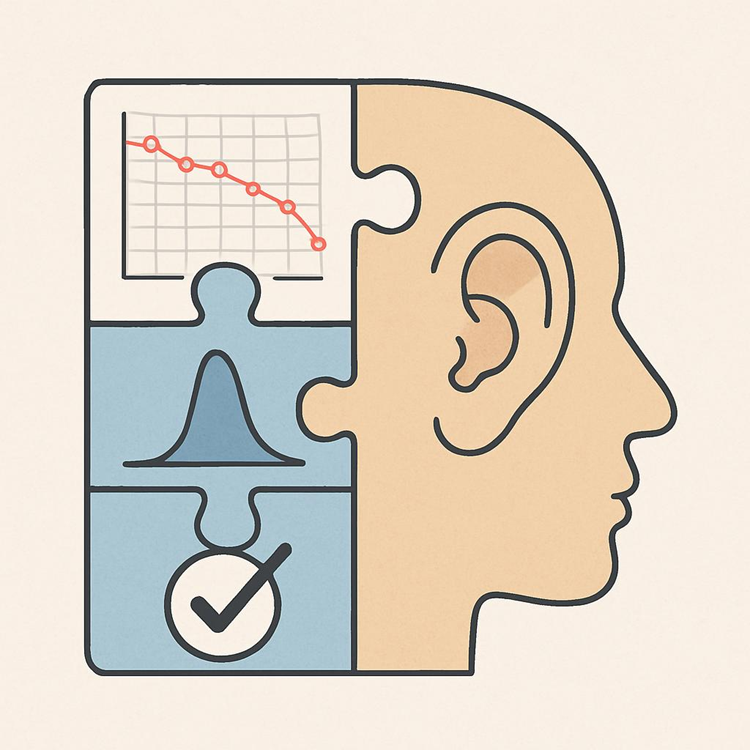
Test Battery Approach and the Cross-Check Principle are more than just concepts to memorize for exams. They are fundamental pillars of audiology best practices that ensure we provide the highest quality care to our patients. Relying on a single test is like navigating with an incomplete map; using a comprehensive, cross-checked battery gives us the detailed, reliable information needed for an accurate hearing diagnosis.
Embracing these principles from the outset will build a strong foundation for clinical audiology skills. It fosters critical thinking, attention to detail, and a commitment to evidence-based practice. Mastering these techniques is key to confidently assessing hearing, interpreting results accurately, and ultimately, making a real difference in the lives of individuals with hearing and balance disorders. Keep learning, keep questioning, and keep cross-checking!