
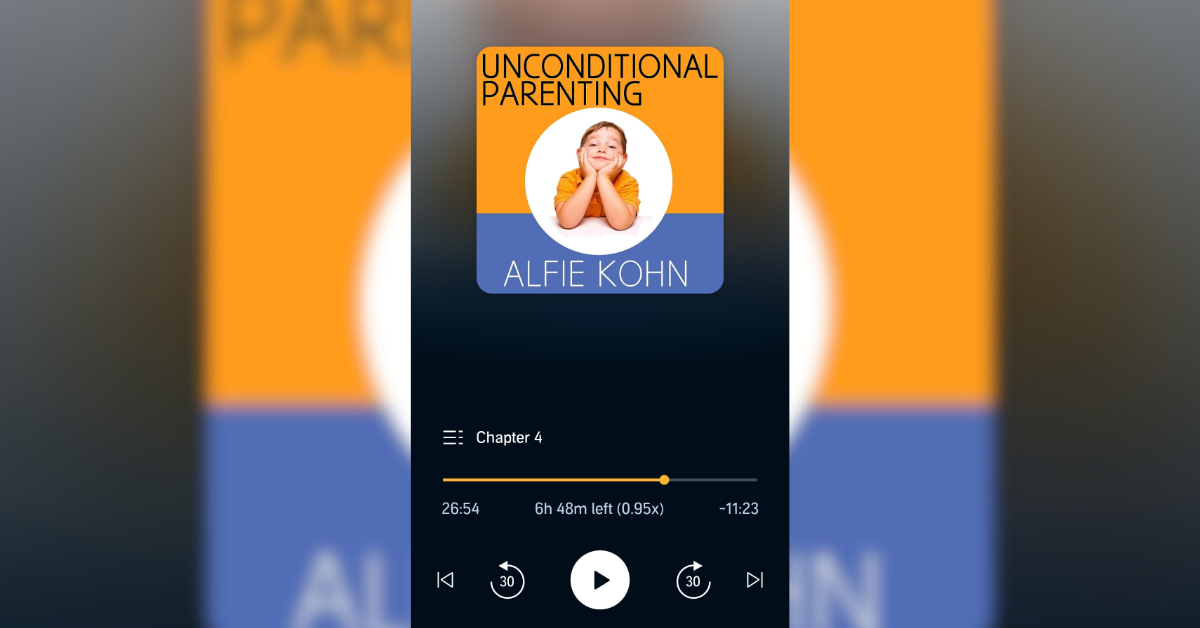
A Book Challenged everything I Know
The whole world opened up to me when I learned to read
– Mary McCleod Bethune
I started this blog with a few goals in mind. One of which was to continue to read. It made me more welcoming and accommodating of others views it has made me more accepting less irritable.
I am writing this blog, five chapters into a book. A book that has taken, what I knew to be true and effective, something that I practiced quiet regularly, and has turned it on its head. I have done such a blog post before on a book that changed my perception of time specifically and life in general. This book however changed my views on relationships, dealing with people (kids to be specific) and has challenged most of what I have fundamentally known about therapy for communication disorders (reinforcement, punishment).
I hence urge you to read the book especially if you are around a child. A parent, a care-giver or a therapist, should definitely read Unconditional Parenting: Moving from Rewards and Punishments to Love and Reason by Alfie Kohn.
Traditional Parenting: The elephant not addressed
As a student of Audiology and Speech Language Pathology we have studied and continue to study about reinforcements, types and schedules. We also have studied types of punishments and reinforcements. Most of our daily practices involve operand conditioning to modify behaviors. A punishment followed by a response to reduce it. A reward followed by a response to increase it.
It looks logical and hence we follow this model, while dealing with more or less everything. I was though shocked to read that these techniques were devised for pigeons in the mid 1900s and not humans. We chose to implement them on humans anyway.
The Problems these successful techniques cause
Punishment
The book shows with proven research how using punishment and even rewards makes life difficult for a child. I was shocked again to read that rewards as small as verbal praises affect the child in the same way as punishment does.
It is widely accepted that hitting kids is inappropriate and not acceptable. So I won’t write about it.
Although hitting or shouting on a child may:
- Cause him to believe that hitting someone weak is perfectly acceptable.
- As with other traditional techniques described later here also the child comes to understand that you don’t love him as much, and he wouldn’t either.
The next best thing is parents do to reduce a response they deem socially not acceptable is Time out.
A way of negative punishment which makes sense, doesn’t it?? Removing something which is pleasurable to the child, to get him to stop doing something. But often times what are we removing?? LOVE, TIME OUT OF LOVE is what it mostly is. We may get temporary obedience from the child, but at what cost??
- This leaves the child scared.
- May even make it hard for them to trust people.
- May make them controlling or manipulative later in life.
- The child growing up with this around may start believing that it is okay to sometimes be cold, merciless and withdrawn from people we love.
Rewards
The flip side of the coin is reward system ranging from anywhere between rewarding things to milder versions of verbal praises in response to a behavior.
We must all face the choice between what is right, and what is easy.
-Professor Albus Dumbledore
This is equally damaging to a child proven by various researches in the book. Rewards according to the book may lead to:
- Academically: The child focusing more on rewards and hence less on learning. This may even lead to the child choosing easier tasks as opposed to tasks that may result in new learning.
- Morally: A child when works only for rewards will go to any length to be able to get it. So fulfilling the task at any cost becomes his motive. He wouldn’t care of anything or anyone but just the reward.
- Generally: Any activity is just done to achieve a reward and hence the child may not do it if it is not rewarding enough later.
- There are other problems that may result from reward or punishment. Reading the book will give you an insight into them.
How does it affect a child??
It is clear that rewards and punishment are just devised to control the behaviors from the outside without understanding or considering what is causing them on the inside. This may result in a lot of issues.
- As mentioned above the child may develop a smudge idea of love and relationships.
- This also affects his/her moral compass.
- Makes them look for validation everywhere.
- May result in anxiety and depression from an early age.
- Can result in a fear of failure which in turn makes them deliberately underperform or chose easy instead of interesting or right.
- May kill the curiosity of a child.
- Research explained in the book supports that this controlling behavior of a parent may also result in eating disorders in a child.
- The child may hide things from the parents. So much so that it feels he is an entirely different person behind their back.
- As the child has just based most his emotions on rewards and punishments, he may not feel much in there absence.
- Among other things he may not feel loved and hence may chose not to love you back.
If not this than what??
Reading the book I came to the understanding that everything I know is a lie. After the initial few pages I could only think to myself, “If not this than what?” Now as every child is different there is no fool proof strategy to achieving a balance. The book however highlights a few principles, which again should be read in the words of the author. He did a better job at explaining those than I ever will.
What I got from the book:
- We have to work with the child instead of working on them.
- Not controlling on the outside but understanding from the inside.
- Not forcing them into doing something with rewards and punishments but guiding them through something.
- Helping them make better choices for themselves. Not burdening them with our choices, now matter how apt we think we chose for them.
Words are, in my not-so-humble opinion, our most inexhaustible source of magic. Capable of both inflicting injury, and remedying it.
-Professor Albus Dumbledore
As I was going through this book I saw a Facebook Post that sort of described this in the best possible way.
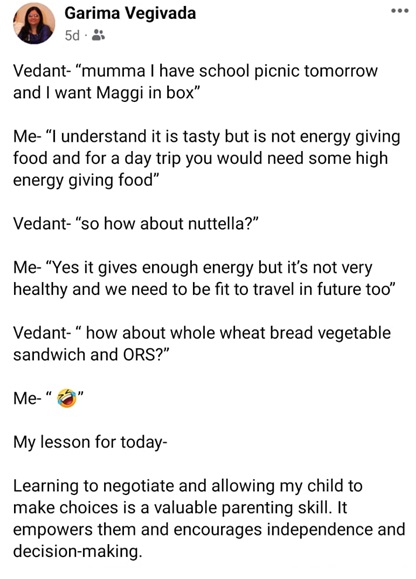
Conclusion
I was wrong, wrong in the way I thought, what was the best way to deal with kids and people in general. I am happy, I read this book soon enough. Today marks the day I will force myself to choose right, instead of the easy, choose being a guide instead of being a enforcer choose, unconditional love instead of conditional appreciations.
Here is to being a better person.