
Why Do Audiologists Use Masking During Hearing Tests?
If you’ve ever had a hearing test, you might’ve noticed the audiologist playing sounds in one ear while adding noise to the other. Strange, right? But there’s a smart reason for it! This technique is called clinical masking — and it helps make sure each ear is tested correctly, one at a time.
In this blog, you’ll learn:
- What cross hearing is (and why it happens)
- How interaural attenuation (IA) affects sound
- Why the plateau method is the gold standard for accurate results
Let’s break it all down!
What Is Cross Hearing?
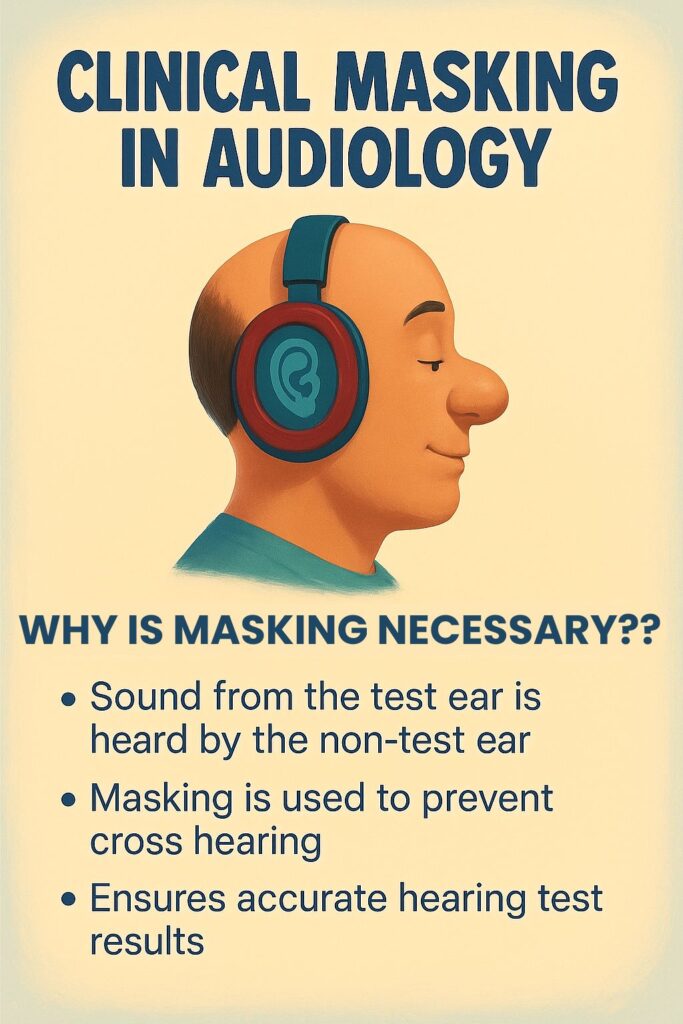
During a hearing test, sounds are sent to one ear at a time. But if the sound is loud enough, it can “leak” through your skull and reach the other ear. This is called cross hearing.
Why is this a problem?
Because if the non-test ear hears the sound and responds, your results won’t be accurate.
That’s where masking noise comes in. It blocks the non-test ear so the audiologist can be sure they’re testing the correct one.
Interaural Attenuation (IA): How Sound Travels Between Ears
When sound travels from one ear to the other, it loses some strength. This loss is called interaural attenuation (IA).
What affects IA?
- The type of transducer (testing device)
- Bone vibrator: No sound loss (IA = 0 dB) → High chance of cross hearing.
- Supra-aural headphones: Moderate sound loss (~40 dB IA).
- Insert earphones: Highest sound loss (~70 dB IA) → Least likely to cross over.
- The sound’s frequency.
Higher or lower frequencies behave differently, but the device used has the biggest impact.
Key point:
Lower IA means sound can easily reach the wrong ear. When this happens, masking becomes necessary!
When Is Masking Needed in Hearing Tests?
Audiologists use masking when they suspect cross hearing might affect your results.
Common signs:
- The air-bone gap between the test ear AC and the better BC (Air opposite bone gap) is:
- more than 10 dB. (BC masking)
- more than 40 dB (AC masking)
- more than 70 dB (AC masking insert earphones)
- The sound is strong enough to reach the non-test ear’s hearing threshold.
- Presence of a shadow curve.
Without masking, the test might pick up the wrong ear’s response — leading to an inaccurate result.
The Plateau Method: Finding the True Hearing Threshold
Introduced by Hood in 1960, the plateau method is the most trusted way to confirm hearing test results.
Here’s how it works:
- The audiologist increases the masking noise in the non-test ear step by step.
- If the test ear’s response stays the same for a few steps, this steady range is called the plateau.
- The hearing level recorded in the plateau is your true threshold.
How the Plateau Method Works (Step-by-Step)
👉 Start with a 5 dB step size for both the tone and the masking noise.
- If the person hears the tone:
🎧 Keep the tone level the same and increase the noise by 5 dB. - If the person doesn’t hear the tone:
🔊 Keep the noise level the same and increase the tone by 5 dB.
💡 Once you get three consecutive “yes” responses — where the tone stays the same but the masking noise is still going up — that spot is the true threshold of the test ear!
3 Masking Zones to Know:
- Under-masking: The noise is too soft. The non-test ear still helps out.
- Plateau: The perfect range — only the test ear is responding.
- Over-masking: The noise is too loud and starts affecting the test ear, making results unreliable.
The audiologist’s goal is always to reach the plateau for clear, accurate hearing test results.
🎯 Handy Masking Formulas for Audiology
When it comes to clinical masking, there are key formulas you should know. These help audiologists set the right noise levels in the non-test ear during a hearing test!
💡 Minimum Masking Level
MML = Air Conduction Threshold of Non-Test Ear (NTE) + 10 dB + Occlusion Effect (if applicable)
👉 This is the starting point for masking. The extra 10 dB ensures the noise is loud enough to block out the non-test ear’s response. If you’re testing bone conduction, don’t forget to add the occlusion effect based on the frequency!
💡 Maximum Masking Level (MML)
MML BC = Bone Conduction Threshold of the Non Test Ear (NTE) + Interaural Attenuation (IA)
MML AC = Bone Conduction Threshold of the Test Ear (TE) + Interaural Attenuation (IA)
👉 This is the upper limit for masking. If you go beyond this, the noise might actually cross back over and affect the test ear — which we call over-masking.
Why Masking Matters
Clinical masking may sound technical, but it’s key to getting reliable hearing test results. It stops one ear from “cheating” for the other!
By using masking and the plateau method, audiologists make sure your hearing levels are measured correctly — ear by ear.
So, next time you hear that masking noise during your test, don’t worry. It’s not there to confuse you — it’s there to help you!
Got questions about hearing tests or masking?
Ask your audiologist, or me if you want to — we’ll be happy to help!
[…] speech audiometry to see how your ears perceive speech ! Like discussed in the previous post about masking in pure tone audiometry the mischievous better ear may help the poorer ear cheat in this test as well hence, Audiologists […]