
When you go for a hearing test, it might seem like all you need to do is raise your hand when you hear a sound. But there’s more happening sometimes the audiologist performs speech audiometry to see how your ears perceive speech ! Like discussed in the previous post about masking in pure tone audiometry the mischievous better ear may help the poorer ear cheat in this test as well hence, Audiologists use smart techniques — like speech audiometry masking — to make sure your results are clear and correct.
In this guide, we’ll discuss on :
- Why masking matters in speech audiometry
- The type of noise used (and why!)
- Three easy-to-understand masking methods
Let’s break it down!
Why Do Audiologists Use Masking?
Imagine this: the audiologist is testing your left ear, but your right ear hears the sound too. This can confuse the results and make it hard to know which ear is really doing the listening.
Masking solves this problem. It sends special noise into the non-test ear (the ear not being checked) to keep it busy. This way, only the test ear responds, and the audiologist gets a true picture of your hearing.
What Noise Is Used for Masking?
Not all sounds work for masking! Since speech is a multi frequency stimulus, audiologists use something called speech-shaped noise.
This noise is designed to match the energy of real human speech. It works better than regular white noise, which can leave gaps and miss parts of the sound range.
Speech-shaped noise:
- Matches the way speech sounds
- Stops the non-test ear from helping out
- Helps audiologists get clear, accurate results
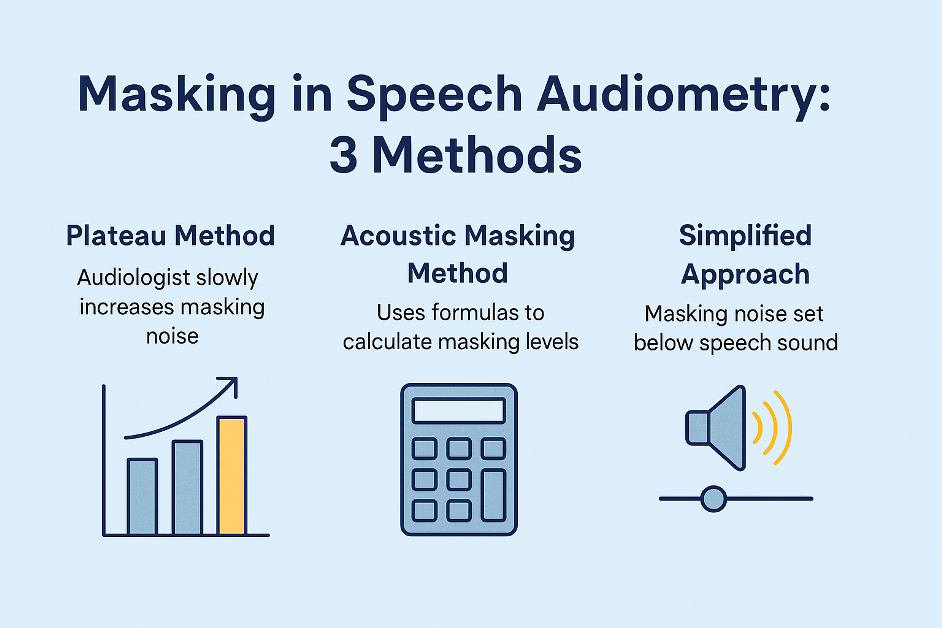
3 Common Masking Methods Explained
1. The Plateau Method
This is the classic, approach. Here’s how it works:
The audiologist slowly increases the masking noise in small steps while rechecking the test ear’s hearing response each time. When the responses from the test ear stop changing, even as the masking noise goes up, the audiologist knows they’ve reached a “plateau.” This means the test ear’s true hearing level has been found.
This method is reliable, especially for detecting the softest sounds you can hear (called detection tasks). But when the test focuses on understanding speech (called recognition tasks), the method can take a little longer and feel more repetitive.
- The audiologist starts with a little masking noise.
- They slowly raise the noise level and test the ear each time.
- When the ear’s response stops changing — that’s the “plateau” — they’ve found the true hearing level.
Best for: Detecting the softest sounds.
Note: It’s reliable but can take longer for speech tests.
2. The Acoustic Masking Method (Formula-Based)
This method uses math instead of guesswork! Audiologists calculate:
- The minimum and maximum masking levels
- The mid-masking level (the perfect balance point)
If the Plateau Method sounds like a lot of back-and-forth, the Acoustic Masking Method takes a different approach — it uses math!
Audiologists use formulas to calculate the minimum, maximum, and mid-levels of masking noise that should be sent into the non-test ear. The most helpful number is the mid-masking level. Why? Because this level perfectly balances out the interaural attenuation.
When the mid-masking level is used, audiologists can feel confident that the test ear is giving a true and clear result. This method saves time and reduces the guesswork — a win for both the patient and the professional.
This approach helps cancel out sound that travels between your ears (IA). It’s faster than the Plateau Method and just as accurate.
3. The Simplified Approach (Quick method)
This is a shortcut method. The masking noise is set about 20–25 dB lower than the speech sound.
But there’s a catch! This method only works when:
- Your ears have minimum ABG (normal hearing or SNHL)
- Mostly used only when the width of the plateau is larger
- Only used for supra threshold measurements like WRS
If used incorrectly, the results might not be reliable as it may fall in UNDER MASKING or OVERMASKING. So audiologists use this method only in the right situations.
Note: Since it can only be used when the width of the plateau is larger it can almost always be used for masking in SRT and WRS when using Insert Earphones.
📐 Masking Formulas at a Glance
For those who like the math side of things, here are the key formulas audiologists use in speech audiometry masking:
🔹 1. Plateau Method (Psychoacoustic)
No strict formula — instead, follow this rule of thumb:
- Initial Masking Noise = SRT (Speech Recognition Threshold) of Non-Test Ear + 10 dB
- Increase masking noise in 5–10 dB steps
- When the test ear’s response stays stable across 15–20 dB of masking, you’ve hit the plateau
🔹 2. Acoustic Masking (Formula-Based)
This approach uses formulas to calculate masking levels:
- Minimum Masking Level
= Presentation Level in Test Ear − Interaural Attenuation (IA) + Largest Air-Bone Gap in Non-Test Ear - Maximum Masking Level
= Best Bone Conduction Threshold of Test Ear + IA − 5 dB - Mid-Masking Level (Most effective)
= (Minimum Masking Level + Maximum Masking Level) ÷ 2
This “sweet spot” helps avoid both under-masking and over-masking.
🔹 3. Simplified Approach (Quick Screening)
A shortcut often used in limited situations:
- Masking Level = Test Ear’s Speech Presentation Level − 20 to 25 dB
✅ Works only if there’s no conductive hearing loss and speech is presented at a high enough level.
Conclusion: Masking Makes Hearing Tests Fair and Clear
Speech audiometry masking is all about fairness. It makes sure both ears are tested one at a time, without the other ear helping out. By using the right noise and the right method — whether it’s the Plateau Method, the Acoustic Masking Method, or the Simplified Approach — audiologists get the most accurate results possible.
So next time you take a hearing test, you’ll know there’s a smart system behind it, making sure your hearing is tested clearly, fairly, and one ear at a time!