
Introduction: Why Acoustics & Calibration Matter
Imagine you’re using a weighing scale that’s off by 5 kg. Every measurement you take would be wrong, and any diet or exercise plan based on those measurements would be flawed from the start.
In audiology, our “scales” are the audiometers and other testing equipment we use to measure hearing.
❗ When these instruments aren’t properly calibrated, the consequences can be serious: inaccurate diagnoses, inappropriate hearing aid fittings, and ultimately, patients who don’t receive the help they need.
Why This Matters
As future audiologists, the accuracy of your testing equipment directly impacts your patients’ quality of life.
Understanding calibration isn’t just a technical requirement—it’s an ethical responsibility.
Pure Tones: The Building Blocks of Hearing Tests
What Is a Pure Tone?
A pure tone is a sound wave consisting of a single frequency.
Unlike the complex sounds we hear in everyday life (which contain many frequencies), pure tones allow us to test specific parts of the cochlea in isolation.
The Diagnostic Power of Pure Tones
Think of the cochlea as a piano keyboard stretched out along its length:
- High frequencies stimulate the base (near the middle ear)
- Low frequencies stimulate the apex (deeper inside)
By using different pure tone frequencies, we can test different “keys” on this keyboard.
Key Concept
Pure tones help us create an audiogram—a “map” of hearing sensitivity across different frequencies.
This map guides everything from diagnosis to treatment planning.
Decibels Demystified: dB SPL vs dB HL
One of the most confusing aspects of audiology is understanding the different decibel scales we use.
Let’s break them down into simple terms.
dB HL and dB SPL are two ways to measure sound, like how we use inches and centimeters to measure height. They both use something called “decibels (dB)”, which is a number that tells us how loud a sound is.
📏 dB SPL (Sound Pressure Level)
- This is like using a ruler to measure sound.
- It tells us how strong or powerful the sound is, like how loud a drum or a speaker is in the real world.
- Example: A whisper might be 30 dB SPL, and a rock concert might be 120 dB SPL.
🧠 dB HL (Hearing Level)
- This is made to measure how people hear sounds.
- It’s like grading how well someone can hear compared to normal hearing.
- 0 dB HL means “normal hearing” for that pitch. It doesn’t mean “no sound”—just that it’s the softest sound most people can hear.
🎧 An Easy Example:
Imagine a super quiet beep:
- A machine measures it as 40 dB SPL (it’s really that loud).
- But for most people, that’s the softest sound they can hear at that pitch.
- So in hearing tests, that sound is called 0 dB HL.
So in short:
- dB SPL = How loud the sound actually is.
- dB HL = How loud it seems to your ears compared to normal hearing.
✅ Why dB HL?
Because our ears aren’t equally sensitive to all frequencies.
The dB HL scale normalizes this variation so that “0 dB HL” always means average normal hearing—regardless of pitch.
Transducers: The Tools We Use to Test Hearing
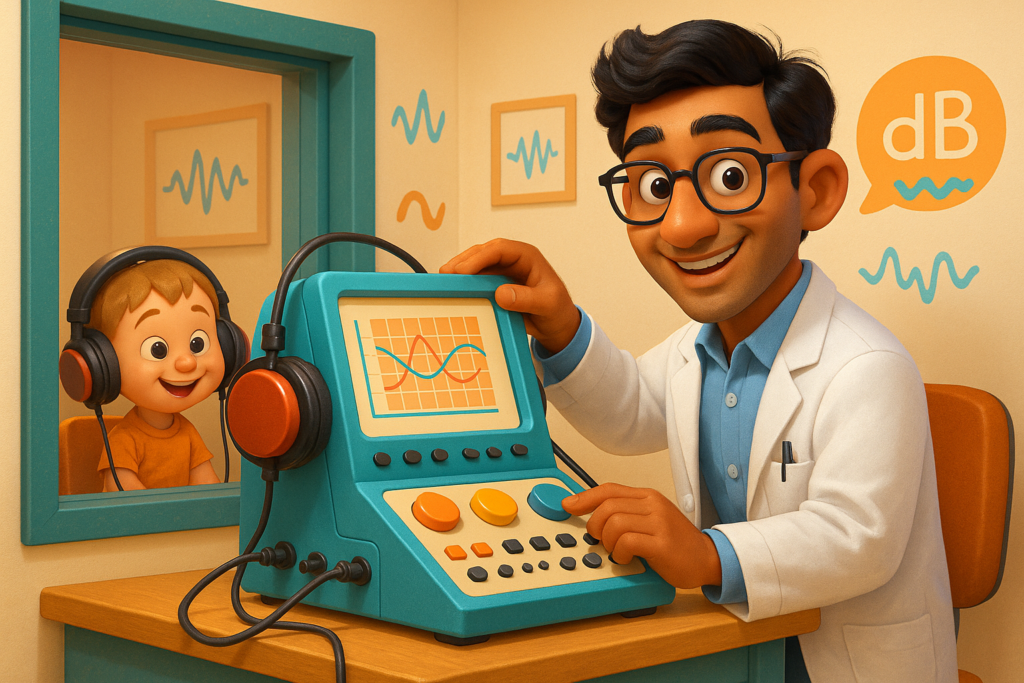
A transducer converts one form of energy into another. In audiology, our transducers convert electrical signals from the audiometer into sound waves (or vibrations, for bone conduction).
Types of Transducers
Supra-aural Headphones (e.g., DD45)
These sit on the ear with cushions pressing against the pinna. They’re the most common type for routine testing. The cushions rest on the ears, with the headband providing enough pressure to create a seal.
Circum-aural Headphones
These fit around the ear, enclosing the entire pinna. They’re often used for high-frequency testing or when better sound isolation is needed.
Insert Earphones (e.g., IP30)
These fit into the ear canal using foam tips. They’re excellent for testing children (harder for little hands to remove) and for reducing the chance of collapsing ear canals in older patients.
Bone Vibrators/Conductors (e.g., B71, B81)
These are placed on the mastoid process behind the ear and vibrate the skull directly, bypassing the outer and middle ear. This helps us differentiate between conductive and sensorineural hearing loss.
⚠️ Clinical Tip:
Each type of transducer has its own unique calibration requirements. You can’t simply swap one type for another without potentially invalidating your test results!
Why Calibration is Critical
Calibration answers two questions:
- Are pure tones being emitted at the correct level?
- Are they emitted at the correct frequency?
Without proper calibration, results can be:
- Inaccurate
- Misleading
- Ethically questionable
🔴 Consequences of Poor Calibration
- Hearing thresholds appear better or worse than reality.
- Hearing aids may be programmed inaccurately.
- Missed or misdiagnosed hearing loss.
- Inconsistent results across time/clinics.
Real-World Impact:
If a patient has a true 45 dB loss, but your uncalibrated audiometer shows 30 dB loss, their hearing aids will be underpowered.
The Calibration Process: A 3-Tier Approach
Calibration isn’t a one-and-done process. It happens at different levels of frequency and intensity.
Stage A: Daily Checks
These quick checks are performed daily before seeing patients:
- Visual inspection: Check for obvious damage or disconnected leads
- Listening check: The “biological test”—listen through headphones for any unusual sounds, distortions, or imbalances
- Serial number verification: Ensure transducers haven’t been swapped
While these checks won’t catch subtle calibration issues, they’ll alert you to major problems before they affect patient care.
Stage B: Periodic Technical Checks
These more thorough checks are typically done annually (though standards recommend every three months):
- Output levels: Measuring the actual SPL produced at each HL setting
- Frequency accuracy: Ensuring tones are at the exact frequency they claim to be
- Distortion: Checking that pure tones are truly “pure” without harmonics
- Attenuator linearity: Verifying that changes in the dial setting produce proportional changes in output
- Cross-talk: Making sure sound doesn’t leak from one channel to another
Stage C: Fundamental Calibration
This most basic level of calibration might only happen once or a few times in an instrument’s lifetime. It involves the most fundamental adjustments to the device’s electronic systems.
Important:
Never swap transducers between audiometers without recalibration! Each transducer is calibrated specifically to work with a particular audiometer.
Calibration Process: Simplified Steps
When a technician calibrates your audiometer, here’s what happens:
- The transducer (headphone or bone vibrator) is connected to a specialized device called a “coupler.”
- For air conduction, this coupler mimics the ear canal’s volume and acoustic properties.
- For bone conduction, an “artificial mastoid” is used that simulates the mechanical properties of the skin and bone.
- A sound level meter is connected to measure the actual output (it measures intensity and also frequency through spectral analyzer inside the SLM).
- The technician plays tones at various frequencies and intensities.
- They compare what the audiometer is set to produce versus what’s actually being produced.
- If there are discrepancies, adjustments are made until the output matches the expected values (or degree of tolerance).
Tolerance is the amount of error which is in an acceptable range while calibrating an equipment. It roughly is +-3% for frequency and +-3dB for intensity
🔢 The Magic Formula
Calibration technicians use this basic equation:
Target SPL = Dial Setting + Reference Value (RETSPL) + Any Correction Factors(based on transducer)
The “Reference Value” comes from international standards that tell us what SPL should be produced when the audiometer dial is set to 0 dB HL for each frequency and transducer type.
- RETSPL = Reference Equivalent Threshold SPL (from standards)
- Adjustments ensure 0 dB HL equals correct SPL at each frequency
Clinical Relevance: Why It All Matters
🎯 Valid Test Results
- Accurate thresholds = Correct diagnoses
- No surprises when fitting hearing aids
🔄 Consistency Over Time
- A test done today = same results if done elsewhere or 5 years later
⚖️ Legal & Ethical Responsibility
- Calibration is often legally required
- More importantly, it’s your duty to provide accurate care
📋 Tips for the Clinic
- Always perform daily listening checks before testing patients. Your ears are valuable tools!
- Know your equipment’s serial numbers and make sure they match what’s documented.
- If something sounds “off,” trust your instinct and have the equipment checked.
- Keep a log of when calibration was last performed and when it’s due again.
- Remember that different transducer types (headphones vs. inserts vs. bone vibrators) will give slightly different results, even when perfectly calibrated, due to how they couple with the ear.
🙌Good audiologists know how to use their equipment. Great audiologists understand how their equipment works.
A video on calibration by intracoustics
[…] Maintain and calibrate equipment regularly: Even small deviations in equipment performance can affect test accuracy. […]